


Boiler stopped working in the cold? How to unfreeze a frozen condensate pipe
If your condensing boiler stops in freezing weather, the white condensate pipe outside has probably frozen. How to find the ice, thaw it safely with warm water, reset the boiler, the fault codes each maker gives, when to call an engineer, and how to stop it happening again, with a checker.
 HanaHow12 minute read
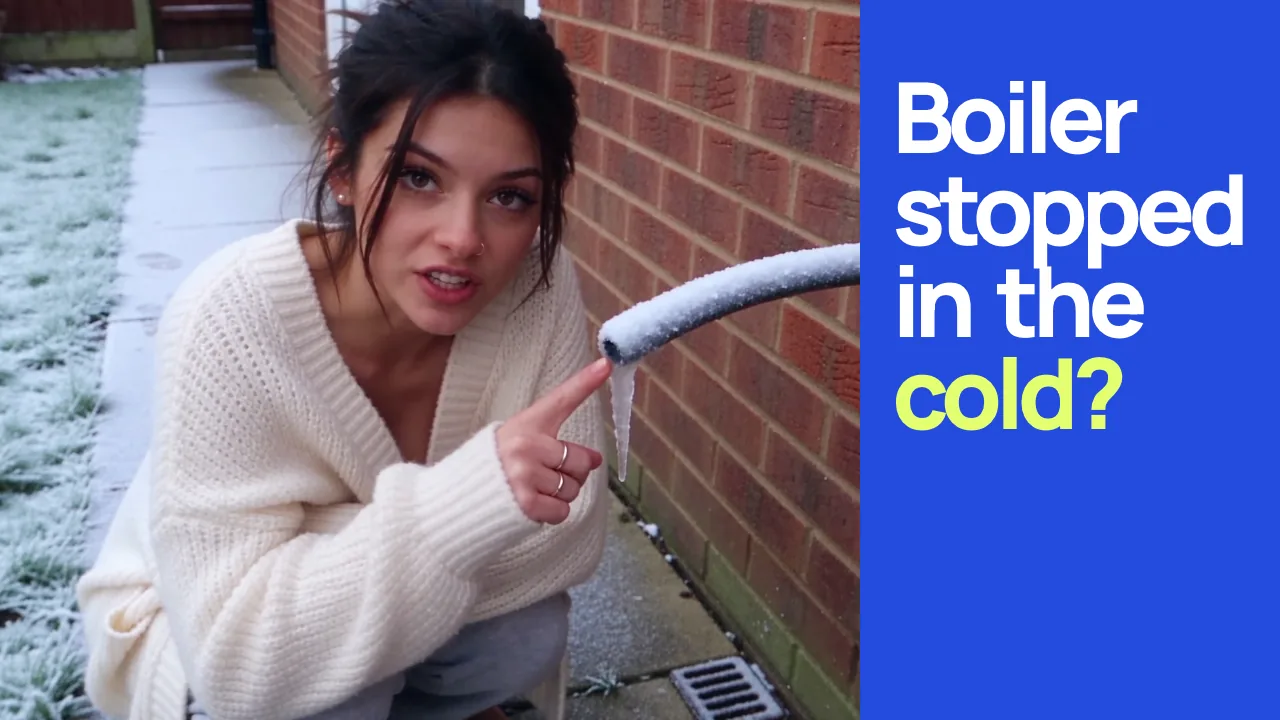
If your gas boiler stops in freezing weather and gurgles or shows a fault code, the likeliest cause is a frozen condensate pipe: the white or grey plastic pipe that carries water from the boiler to a drain. If it runs outside and you can reach it from the ground, you can usually thaw it yourself with warm water, then reset the boiler. The checker below takes you through it and tells you when to call someone instead.
If you smell gas, that’s a different problem: leave the boiler alone, open the windows, don’t use light switches or naked flames, and call the gas emergency line on 0800 111 999 in England, Scotland and Wales, or 0800 002 001 in Northern Ireland. A frozen condensate pipe isn’t a gas emergency, so for that, call a Gas Safe registered engineer if you can’t fix it yourself.
Is it your condensate pipe?
Tick what’s happening and pick your boiler. It says how likely a frozen condensate pipe is, and what to do next.
It’s very likely your condensate pipe.
EA is a code Worcester Bosch links to the condensate pipe (Greenstar Si Compact and i System Compact user manuals: “Condensate outlet blocked”). It can mean other faults too.
- Only if you can reach it from the ground: find the frozen part, usually the open end, a bend or a dip. Warm it with a hot water bottle, a microwavable heat pack, or warm water poured slowly along it. Never boiling water, and never from a ladder.
- Mind your feet: the water freezes where it lands. It can take a few goes.
- Once it runs, reset the boiler as its manual says. If it won’t restart, call a Gas Safe registered engineer.
It weighs the signs the boiler makers give, as a place to start. It can’t see your boiler, so if you’re not sure, a Gas Safe registered engineer can check.
The signs
The boiler makers list the same signs:
- No heating or hot water after a spell below freezing.
- A gurgling or bubbling noise from the boiler or the pipe, often while it tries to light.
- It tries to light, then stops and locks out, with a fault code or a flashing light. Ideal’s Logic Heat2 guide describes it: the condensate “will build up to a point where it will make a gurgling noise prior to locking out”.
- Ice or frost on the pipe outside, often at its open end.
Look under the boiler for the pipe. If there’s a white plastic pipe coming out of the wall nearby and running down to a drain, that’s it. A boiler with no condensate pipe isn’t a condensing boiler, so this isn’t your problem.
If the pipe runs inside to a sink or washing machine waste, a blocked waste can cause the same gurgling and lockouts in any weather. Baxi suggests checking whether the sink is slow to drain.
If the pressure gauge reads below about 1 bar, low pressure can stop a boiler on its own, and our guide to a boiler losing pressure covers it. If the boiler runs but a radiator is cold at the top, that’s air, and you can bleed the radiator.
Fault codes by make
These are the codes each maker ties to a blocked or frozen condensate pipe in its own manual or advice page. Most of them really mean the boiler failed to light, so they can point to other faults too. Your boiler’s manual is the final word.
| Make | Code | Where the maker says so |
|---|---|---|
| Worcester Bosch | EA | Greenstar Si Compact and i System Compact user manuals: “Condensate outlet blocked”. Worcester’s frozen condensate page says digital displays “may” show EA. |
| Worcester Bosch | 227 | Greenstar 4000 and 8000 Life installation manuals: “No flame signal after ignition”, with “Condensate pipe is frozen” as a cause. |
| Worcester Bosch | flashing reset light | Greenstar 24i and 28i Junior: “a flashing Reset light on the control panel”. |
| Ideal | L2 (or L02) | Logic Heat and Logic Heat2: “Ignition Lockout”, check the condensate pipe for blockages. |
| Ideal | L0d | Logic Heat2: “Blocked Flue/Condensate”. Logic MAX Combi2, Logic+ Combi and Vogue MAX show the words “Ignition Lockout” instead of a code. |
| Baxi | E.04.10 | 600 and 800 Combi 2 quick start guide: “Frozen condensate pipe”. |
| Baxi | E133 | Baxi’s advice pages, for “most Baxi boilers”: “a problem with either the gas supply, ignition/flame or a blocked condensate”. |
| Vaillant | F28 or F29 | Vaillant’s advice page, which says it’s “the same code on all boiler models and types”. |
| Glow-worm | F28 or F29 | Glow-worm’s frozen condensate page. |
| Viessmann | F4 | Viessmann’s advice page for Vitodens boilers. Its own fault code tool doesn’t list F4, so check the manual. |
Some Baxi pages also mention E28. Baxi’s own code table calls 28 a flue sensor fault, so we’ve left it out.
Why a condensing boiler makes water
Burning gas makes water. Each molecule of methane, the main part of natural gas, burns into one of carbon dioxide and two of water, as steam in the boiler’s exhaust. About a tenth of the gas’s energy is held in that steam.
A condensing boiler cools its exhaust until some of the steam turns back into water, and keeps the heat it gives off. That’s why it’s more efficient than an old boiler, and why it needs a drain. From 1 April 2005, the government’s guidance for England and Wales said new and replacement gas and oil boilers should be condensing ones “unless there are exceptional circumstances”.
It’s a lot of water. Vaillant’s installation manual gives its ecoTEC plus combis’ condensate as 2.0 to 3.1 litres an hour in its 50/30°C heating test, where water leaves for the radiators at 50°C and comes back at 30°C. The water is acidic: Vaillant puts it at pH 3.5 to 4.0, so the pipe is plastic, and England’s building regulations guidance, Approved Document H, says pipework that takes it should resist a pH of 6.5 and lower.
The water runs out of the boiler through a trap, then down the condensate pipe. Ideally that goes to a drain inside: the soil stack or a sink or washing machine waste. Plenty of older installs run it out through the wall and down to a drain outside instead.
Why the pipe freezes
A thin plastic pipe outside, carrying a slow trickle in a long freeze, can freeze solid. The industry’s installer guide from the Heating and Hotwater Industry Council (HHIC) says frozen pipes happen “in the vast majority of cases” where the pipe runs outside for some or all of its length “and has not been insulated and sealed correctly”.
It usually freezes at the most exposed point outside: “the open end of the pipe, at a bend or elbow, or where there is a dip in the pipe where condensate can collect”, in the HHIC’s words. Wind chill at the open end makes it worse. A pipe that runs through a cold garage or loft can freeze there too.
Once the ice blocks it, the water can’t get out. It backs up into the boiler, a sensor or the failed ignition stops it, and it locks out. Baxi says that’s “a failsafe mechanism to protect the boiler from water going back up the pipe”.
What you’ll need
- A hot water bottle or a microwavable heat pack
Held against the frozen part. Worcester Bosch, Ideal, Baxi and the HHIC all list both.
Microwavable heat packs on Amazon - A jug or watering can of warm water
Never boiling. Which? suggests boiling the kettle and leaving it for 10 to 15 minutes first.
- Grit or salt for the path
Worcester Bosch, Ideal and Baxi all warn that the water you pour can freeze where it lands.
Rock salt on Amazon - Warm clothes
Baxi says to wrap up warm, as you may be outside for some time.
- Outdoor pipe insulation, for later
For lagging the outside run once it’s thawed. Get a waterproof, UV-resistant kind made for outdoors, sized to your pipe. The HHIC asks installers for at least 13 mm, sealed at every joint.
Outdoor pipe insulation on Amazon
Amazon links are affiliate links. If you buy through one, HanaHow gets a small commission and you pay the same. As an Amazon Associate I earn from qualifying purchases.
How to thaw it
Only do this if you can reach the frozen part from the ground. Worcester Bosch’s manuals say “Never attempt to thaw a condense pipe that is at height”, and Ideal’s say not to thaw pipework above ground level.
- Find the frozen part. Follow the pipe from the wall to its end. Look for ice at the open end, at bends and in any dip or sag. If it has insulation, Ideal says to take it off first and refit it afterwards. Viessmann suggests starting at the end if that’s frozen, so the water behind it has somewhere to go.
- Warm it. Hold a hot water bottle or a microwavable heat pack against it, or pour warm water slowly along it from a jug or watering can. Never use boiling water: Ideal says it may crack the pipe, and Baxi says you could burn yourself. Which? suggests boiling the kettle and leaving it for 10 to 15 minutes so it’s warm rather than boiling.
- Keep going. Ideal says “several applications may have to be made” before it fully defrosts. You’ll know it’s clear when water runs out of the end.
- Mind the ground. The water you pour freezes where it lands. Worcester, Ideal and Baxi all warn about the slip hazard, so put some grit or salt down, or pour carefully.
Don’t cut the pipe or take it off the boiler, whatever you’ve seen online. Viessmann says it’s “generally considered to be part of your gas boiler’s flue system”, so only a Gas Safe engineer should work on the pipe itself.
Reset the boiler
Once the water’s running, the boiler usually needs a reset. The HHIC says it’s normally “simply pressing a reset button on the front of the boiler, or in some cases by isolating the electrical supply to the boiler and switching it back on”. The makers’ manuals say:
- Worcester Bosch Greenstar Si Compact and i System Compact: press the reset button for five seconds, then wait two to three minutes. Greenstar 4000 and 8000 Life: press the up and down keys together until Reset shows.
- Ideal Logic Heat2: press the Restart button. Logic MAX Combi2 and Vogue MAX: the Restart option on the screen.
- Baxi 600 and 800 Combi 2: hold the reset button for five seconds. Older models: hold the reset button until the red light goes out, or turn the knob fully anticlockwise and hold it, or turn the selector to R for five seconds.
- Vaillant ecoTEC plus: press the reset button, for longer than three seconds on the 2023 models. Vaillant says to try up to three times.
If it locks out again, the pipe may still be frozen further along, so check it again. If it still won’t start, call a Gas Safe registered engineer.
When to call someone
- The pipe’s up the wall. Don’t climb a ladder in the ice. Call a Gas Safe registered engineer, or wait for a thaw.
- You smell gas. Call the gas emergency line: 0800 111 999 in England, Scotland and Wales, or 0800 002 001 in Northern Ireland.
- A carbon monoxide alarm goes off. Turn the boiler off if you can do it straight away, open doors and windows on your way out, and get everyone outside. Don’t go back in. Call the same emergency number, and get medical advice: NHS 111, or 999 if anyone is struggling to breathe, confused or passes out.
- It won’t restart after you’ve thawed it, or the code is something else. Call a Gas Safe registered engineer, and tell them the code.
- It keeps freezing. The pipe probably isn’t fitted to the current guidance. An engineer can move or upgrade it (see below).
Stop it happening again
Things you can do
- Lag the outside run with waterproof, UV-resistant pipe insulation made for outdoor use. Baxi, Ideal, Vaillant and Viessmann all suggest it. Viessmann warns that lagging that isn’t waterproof can make freezing more likely. Lagging helps, but the HHIC says even well-fitted pipes can freeze “in extreme conditions with widespread and prolonged sub-zero temperatures”.
- Fit a drain cover over the gully where the pipe ends, which cuts the wind chill at the open end. Worcester Bosch suggests it.
- In a long freeze, turn the boiler’s heating temperature up. Worcester Bosch, Ideal and Baxi suggest turning the boiler’s own heating dial to maximum during a cold spell. It runs hotter, so it makes less water, as Worcester’s technical bulletin and Baxi’s video explain. Ideal says you “must return to original setting once cold spell is over”, and Worcester says the boiler runs slightly less efficiently while it’s turned up. This is the dial on the boiler, not your room thermostat.
Jobs for an engineer
The HHIC’s installer guide (Issue 3.0, November 2023) sets out how a condensate pipe should go in. An engineer can bring yours up to it:
- Drain it inside to the soil stack or a sink, bath, shower or washing machine waste. That’s the preferred method. If gravity can’t get it there, they can fit a condensate pump.
- If it has to go outside, keep the outside run as short as possible, no more than 3 metres, on the most direct and most vertical route, with no flat sections where water can sit.
- Use a wider pipe: at least 30 mm inside, typically 32 mm pipe, before it goes through the wall.
- Insulate it with at least 13 mm of waterproof, UV-resistant insulation, sealed at every joint, all the way to the tip, and end it below the drain grating with the end cut at 45 degrees.
- Fit trace heating: an electric heating cable along the pipe with a thermostat, under the insulation.
Some makers sell their own fix too, such as Worcester Bosch’s CondenseSure, which it says was tested at minus 15°C for 48 hours.
The big freezes
The biggest recent freeze with good figures on boiler breakdowns was the Beast from the East, in February and March 2018. The Met Office says “air temperatures in large parts of the country stayed below zero for more than 48 hours”, and it reached minus 14.2°C at Faversham in Kent on 28 February.
- British Gas fixed 145,000 boiler breakdowns in one week, “our busiest week ever and more than twice the normal weekly number”, its owner Centrica said in May 2018.
- The gas emergency line took 42,000 calls on 1 March 2018, more than double its previous record of 18,000 in a day in December 2010, Cadent said, and “many calls were from people experiencing other problems such as broken boilers or no central heating or hot water”. That line is for gas leaks and carbon monoxide. For a broken boiler, call your boiler cover provider or a Gas Safe registered engineer.
- In the cold spell of early 2010, British Gas engineers repaired “up to 35,000 boilers a day during the coldest period, around double the amount normally repaired on a typical winter’s day”, Centrica said.
None of these counts frozen condensate pipes on their own. The HHIC’s 2018 installer guide says the 2010 and 2018 freezes brought “a significant increase in the number of calls to boiler manufacturers and heating engineers” from people whose condensate pipe had frozen. After the 2018 freeze, its director Stewart Clements said “there was a significant proportion of installations that were not installed to current standards and manufacturers’ instructions”.
Sources
- Worcester Bosch: frozen condensate advice, the frozen condensate leaflet, user instructions for the Greenstar Si Compact, i System Compact, Greenstar 8000 Life, Greenstar 4000 and Greenstar 24i and 28i Junior, installation manuals for the Greenstar 8000 Life and Greenstar 4000, technical bulletin TB0028 and CondenseSure.
- Ideal Heating: how to defrost frozen condensate pipes, the Logic Heat troubleshooting guide and the Logic Heat2 user guide.
- Baxi: how to thaw a frozen condensate pipe, how to reset a Baxi boiler, how to stop a condensate pipe freezing, its frozen condensate video, what Baxi error codes mean, the 800 Combi 2 quick start guide and error code tables.
- Vaillant: your condensate pipe in winter, the ecoTEC plus operating instructions (2018 and 2023 models) and the ecoTEC plus installation and maintenance instructions, document 0020244997_02 (copy held by Camden Council). Glow-worm: frozen condensate pipe. Viessmann: how to fix a frozen boiler condensate pipe and its fault code tool.
- HHIC: installer guide to condensate discharge pipes, Issue 3.0, November 2023 and Issue 1.0, October 2018. Heating & Ventilating Review: industry demands strengthened regulations for condensate pipes.
- Government: ODPM Circular 04/2005 on condensing boilers and Approved Document H.
- Gas emergency: Cadent on the March 2018 calls, firmus energy and Phoenix Energy for Northern Ireland. NHS: carbon monoxide poisoning.
- Cold snaps: Centrica’s trading update of 14 May 2018 and 2010 interim results. Met Office: March 2018 statistics and snow and low temperatures, February to March 2018.
- Which?: how to thaw a frozen boiler condensate pipe.
Something not quite right?
Let us know